Book One of The Agentic Future · Yogesh Sharma
The Agentic Mind
From Agents to Agentic Infrastructure
Software used to answer. Now it acts.

The trailer
Monday morning, 2036
50 seconds. Narrated with an AI voice, the one that reads the audiobook; the pictures are AI-made too.
From answers to actions
For most of the history of computing, software waited for us.
We clicked a button. We typed a command. The machine responded. That relationship is beginning to change. The most important shift in artificial intelligence may not be that machines are becoming better at answering questions. It may be that they are becoming capable of pursuing goals.
You don’t ask it for an answer. You give it a job.
- An answer is an output.
- A job is a process.
- The program was told what to do.
- The agent is asked what needs to be done.
“Three decisions require you. Everything else is handled.” In 2036, that is how Maya’s Monday begins. Thirty-eight thousand agents run her company: some persistent, some created minutes ago, some delegated by other agents. One line in the inventory reads only Other, and nobody can say what it means.
The Agentic Mind explains how we get from today’s assistants to that morning: what an agent actually is; how the loop of reasoning, action, and observation works; how agents plan, remember, use tools, operate computers, and conduct research; how they find and talk to one another; and the runtime, memory, control plane, and data plane they need to run safely at scale.
Throughout, the book separates what is deployed today from what is emerging and what is still a proposal, so you can tell evidence from extrapolation.
“Who authorized the next action?”
Prologue
Monday Morning, 2036
At 7:12 on a Monday morning in Seattle, Maya’s apartment was already awake.
Her assistant spoke quietly into the room.
“Good morning, Maya. Three decisions require you. Everything else is handled.”
“There is an infrastructure incident.”
Maya sat up.
“At 2:43 a.m., the Reliability Agent detected an unusual increase in p999 latency during a storage migration.”
“Four independent engineering agents disagree about whether the migration should continue.”
Maya stared at the ceiling. Four agents. Not four engineers. Agents.
“How many agents are in the company now?”
“Thirty-eight thousand.”
Maya stared at the final line. “What does ‘other’ mean?”
The assistant paused. “I don’t know.”
For the first time that morning, Maya felt something she hadn’t felt in years. Uncertainty. Not because the system had failed. Because it had succeeded.
Who is watching all of us?
The year 2036 is a narrative device, not a forecast. Maya is fictional; the systems she encounters are built from trajectories visible today.
Free sample
Read the whole Prologue and Chapter 1
4 parts · 17 chapters
From a single agent loop to the infrastructure beneath it
IThe Age of AgentsChapters 1–4
1From Answers to Actions
How computing is moving from systems that answer human requests to systems that pursue goals and take action.
2What Is an Agent?
A precise definition of agents, agency, autonomy, and the systems required to make software act on delegated intent.
3The Agent Loop
The reasoning–action–observation cycle that turns a language model into a continuously operating system.
4The Autonomy Spectrum
Autonomy as a set of dimensions rather than a binary property.
IIBuilding the Agentic MindChapters 5–9
5Reasoning
How agents plan, choose actions, handle uncertainty, evaluate outcomes, and reason across long-running tasks.
6Memory
Why persistent memory gives agents continuity, identity, experience, and organizational knowledge.
7Tools
How tools connect an agent’s reasoning to data, computation, APIs, and controlled actions in the real world.
8Agents That Use Computers
Operating software through screens, browsers, files, terminals, and other human-oriented interfaces.
9Agents That Research
Investigating questions, evaluating evidence, and beginning to participate in knowledge creation.
IIIThe Agent NetworkChapters 10–13
10Agent Discovery
How agents discover other agents and capabilities in an increasingly populated network.
11Dynamic Agents
How agents can be created, delegated to, evaluated, and retired dynamically.
12Agent-to-Agent Communication
How agents communicate, negotiate, delegate, and exchange context.
13The Agent Mesh
The networking, identity, routing, policy, observability, and trust layer for agent-to-agent interaction.
IVThe Agentic InfrastructureChapters 14–17
14The Agent Runtime
The execution environment that coordinates models, tools, memory, state, policy, and long-running loops.
15The Agent Memory System
The architecture required to store, retrieve, govern, and evolve agent memory at scale.
16The Agent Control Plane
Identity, authorization, policy, discovery, lifecycle, governance, cost, and observability for agents.
17The Agent Data Plane
The execution path where agents reason, use tools, access memory, communicate, and change the world.
Opens with a prologue, Monday Morning, 2036, and closes with a coda, Who Is Watching?
Honest about what is not yet known
Every claim says how sure it is
The book deliberately separates evidence from inference. Each chapter ends with research notes that sort its claims into four kinds - and asks what would prove them wrong.
01
Observed
Capabilities or practices documented in real systems.
02
Emerging
Technologies or patterns being actively developed or deployed, but not yet universal.
03
Proposed
Architectural frameworks developed in the book to organize the evidence and reason about where it may go.
04
Speculative
Forward-looking scenarios that are intentionally not presented as predictions.
Proposed in the book
New tools for thinking about systems that act
The Agent Mesh
The shared layer between agents that provides communication, identity, policy, routing, observability, and governance, so every agent doesn’t have to build them alone.
Delegation Provenance
Every meaningful action can answer not only “which agent did this?” but “who authorized it, through which chain of delegation, and under what policy?”
The Agent Memory System
Memory as a governed system with a write path and a read path: what an agent keeps, what it forgets, and who may read what it remembers.
The Agent Control Plane
Identity, authorization, policy, discovery, lifecycle, cost, and audit for every agent, enforced around the work rather than inside it.
The Agent Data Plane
The execution path where agents reason, use tools, read memory, talk to other agents, and change the world, and where every step can be traced.
These are presented as conceptual tools, not established industry standards - frameworks for a system whose architecture is still being invented.
Early praise
“Systems of agents, not just agents. Sharma grounds agent design in systems and services engineering: the agent mesh, delegation provenance, memory in kinds and lifecycles, and how they fit together. Agents for complex work stop being demos and start being infrastructure.”
— Kawarjit Bedi, Distinguished Engineer “Great way of showing the future of AI in simple words. Interesting read, felt like a movie!”
— Bankim Chandra, CEO & MD, Dotsquares Ltd
Book One of The Agentic Future
Read it here, today
- The complete book, all seventeen chapters, to read online in your browser on any phone, tablet, or computer
- The full audiobook, about six hours, narrated with an AI voice, at no extra cost
- Sign in any time with the email you buy with; no password, no app
This is online reading on this site, not a download: there is no PDF or ebook file. The hardcover, paperback and Kindle editions are on Amazon.
Book Two of The Agentic Future · Coming next
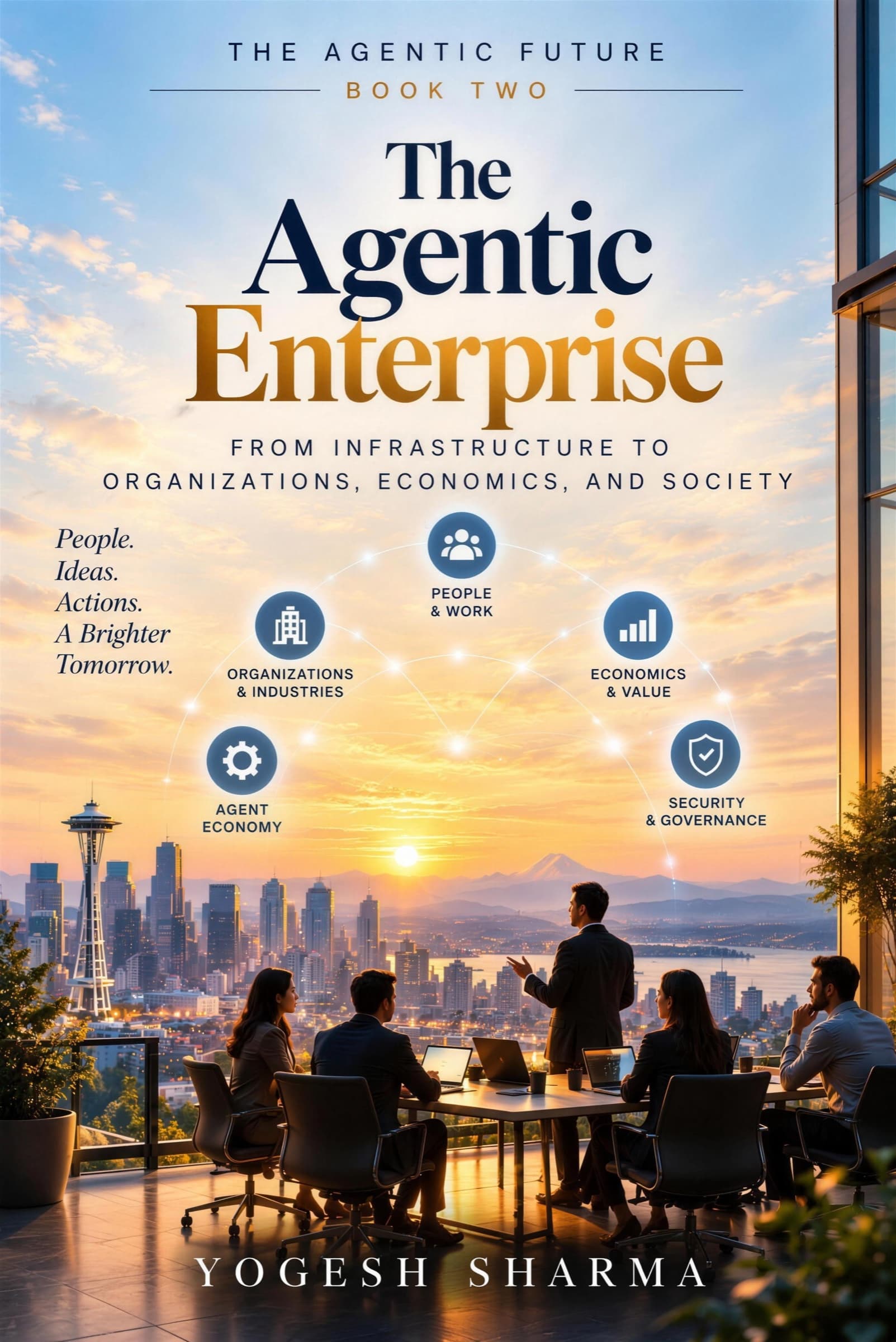
The Agentic Enterprise
From Infrastructure to Organizations, Economics, and Society
Once software can act, who is responsible for what it does?
By 2036, companies run on tens of thousands of agents that recruit specialists, delegate authority, spend money, and create other agents. The capability is here. The hard part is control.
The Agentic Enterprise follows agents into the places where their actions have consequences: organizations of agents, agents managing agents, the one-person company, the ways autonomous systems fail, the attack surfaces they open, the governance that keeps them in bounds, and who is accountable when a delegated decision goes wrong.
It picks up where The Agentic Mind ends, with the infrastructure in place, and asks what organizations, economies, and societies become once that infrastructure is everywhere.
In three parts: The Autonomous Enterprise · The Control Problem · The Agentic World.
“I can tell you what every agent is doing. I can tell you who authorized it, and what it is allowed to do next.
I cannot tell you who should decide what it is for.”

About the author
Yogesh Sharma
Founder and CEO, Befundo
Yogesh Sharma is the founder and CEO of Befundo (Befundo.ai), and an entrepreneur and technology leader building toward the agentic future. He is an alumnus of the Stanford Graduate School of Business LEAD program. With more than two decades of experience in cloud infrastructure, distributed systems, and engineering leadership across Amazon Web Services, F5, T-Mobile, and AT&T, he now focuses on building and exploring agentic AI systems and the organizations that will emerge around them.
He writes to help technical leaders, business executives, and curious minds navigate the next era of intelligence, work, and human potential.
The Agentic Mind
From answers to actions
Not ready yet? Start with the free sample.